Home | About the Director | FAQ | Testimonials | | How to Find Us

Home | About the Director | FAQ | Testimonials | | How to Find Us |
|
About the DirectorQuestions?Conditions We TreatSpecialty ProceduresOur LocationTestimonials |
|
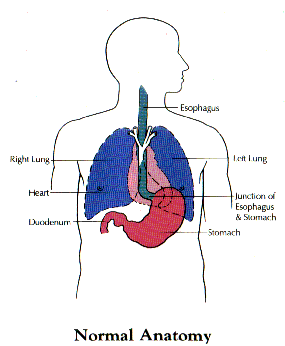
Heartburn / Gastroesophageal RefluxPage 1 | Page 2 What Does it Mean?Heartburn is a Universal Human Symptom. All of us experience heartburn at some time in our lives, and for many of us it is a frequent occurrence. For some people, heartburn is a constant nagging problem. It is described variously as a painful discomfort in the upper abdomen or the lower middle of the chest often associated with burping, and occasionally the burping up of gastric juice into the mouth with a bitter taste that follows. Many people complain of chronic acid indigestion felt as pain or burning in the chest. It is often associated with being overweight. A change in position, such as when one bends over to tie a shoe, can bring it on. It also occurs frequently in the middle of the night, waking the person from sleep. When we talk about heartburn or acid indigestion, what we really mean is the irritation of the lower portion of the swallowing tube called the esophagus by the mixture of food and gastric juice from the stomach. Doctors refer to this as gastroesophageal reflux disease or GERD. Most people experience gastroesophageal reflux as a normal result of eating too much. Spicy food, coffee, alcohol, tobacco, and chocolate often contribute to the problem. If gastroesophageal reflux occurs when the stomach is relatively empty, it is defined as a true disease named GERD. What Causes Reflux? Several factors that cause reflux have been studied for the last fifty years. The process is complicated and not completely understood. For example, the act of swallowing involves a complex coordination of multiple nervous impulses and twenty-six muscles of the mouth, throat, and esophagus. In the past several years, research has focused on the junction between the lower esophagus and stomach and it has now been recognized that the lower esophagus serves two purposes. One of the purposes is to transport food into the stomach by propulsive muscular contractions. The other purpose is to prevent regurgitation of stomach liquid into the lower esophagus. The junction of the lower esophagus and the stomach is referred to as the lower esophageal sphincter. It acts as a valve to prevent stomach fluid from washing back into the esophagus. This normal mechanical function depends upon normal anatomy.
|
|
||
| Site Copyright © 2026 by the Heartburn
Center of San Diego |
|||||
|
|
|
|||