Home | About the Director | FAQ | Testimonials | | How to Find Us

Home | About the Director | FAQ | Testimonials | | How to Find Us |
|
About the DirectorQuestions?Conditions We TreatSpecialty ProceduresOur LocationTestimonials |
|
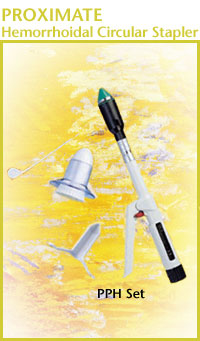
Hemorrhoid StaplerThe newest surgical procedure for advanced hemorrhoids is called the Procedure for Prolapse and Hemorrhoids (PPH). This endoscopic surgery technique was developed in the early 1990s to reduce the prolapse of hemorrhoidal tissue to allow a patient to experience less pain and recover faster than patients who undergo the conventional hemorrhoidectomy procedure. Conventional hemorrhoidectomy procedures are painful because hemorrhoidal tissue is surgically removed, affecting many nerve endings. In comparison, PPH reduces the prolapse of hemorrhoidal tissue by utilizing a circular stapler to trim out a band of tissue above the dentate line, or "pain" line, within the anal canal. The PPH surgical procedure essentially "lifts up" or repositions the anal canal tissue and restores the hemorrhoidal tissue back to its original anatomical position, without cutting sensitive nerve endings. The internal hemorrhoids, then, shrink within four to six weeks after the procedure. PPH Procedure for Advanced Hemorrhoids Involves Less Pain and a Quicker RecoveryIn clinical trials, the Procedure for Prolapse and Hemorrhoids (PPH) has been shown to be a less painful procedure for removal of advanced hemorrhoids when compared to conventional hemorrhoidectomy. PPH is a technique that reduces the prolapse (enlargement) of hemorrhoidal tissue. With the PPH procedure, patients experience less pain and recover faster than patients who undergo conventional hemorrhoidectomy procedures. Since the PPH procedure was first introduced in Italy in 1997, it has become a common procedure around the world for the surgical treatment of hemorrhoids. The procedure was first introduced in the United States in October 2001. How PPH WorksUsing a hemorrhoidal circular stapler device, the procedure for prolapse and hemorrhoids procedure essentially "lifts up," or repositions the mucosa, or anal canal tissue, and reduces blood flow to the internal hemorrhoids. These internal hemorrhoids, then, typically shrink within four to six weeks after the procedure. The PPH procedure results in less pain than traditional hemorrhoidectomy procedures because it is performed above the "pain" line, or dentate line inside the anal canal. The advantage is that this hemorrhoid treatment method affects few nerve endings, while traditional hemorrhoidectomy procedures are performed below the dentate line, affecting many sensitive nerve endings. See our section on Hemorrhoids.
|
|
||
| Site Copyright © 2026 by the Heartburn
Center of San Diego |
|||||
|
|
|
|||